

 English
 Español
 Deutsch

Why Precision Gear Shaft Noise Often Starts from Alignment?
Where Engineering Excellence Meets Reliable Transmission
Inside many transmission systems, noise rarely appears suddenly.
Operators may only hear a light rhythmic sound during acceleration or notice slight vibration at certain rotational speeds. Weeks later, the sound becomes sharper, gear wear increases, and the entire transmission system starts feeling less stable during operation.
In many cases, the problem is not caused by the gear teeth alone.
With a precision gear shaft, very small alignment changes can gradually affect how force transfers across the entire rotating assembly.
Actually, some gear systems begin generating abnormal vibration long before visible wear appears on the tooth surface itself.
Rotational Accuracy Changes Load Distribution
A precision gear shaft does more than simply connect rotating components together.
During operation, the shaft controls how evenly torque transfers through the gear mesh. If rotational accuracy shifts slightly because of machining deviation or installation stress, contact pressure across the gear teeth becomes uneven.
This often affects:
- tooth engagement stability
- vibration behavior
- bearing load distribution
- rotational smoothness
- long-term wear consistency
Actually, even micron-level shaft deviation may influence gear noise once rotational speed increases.
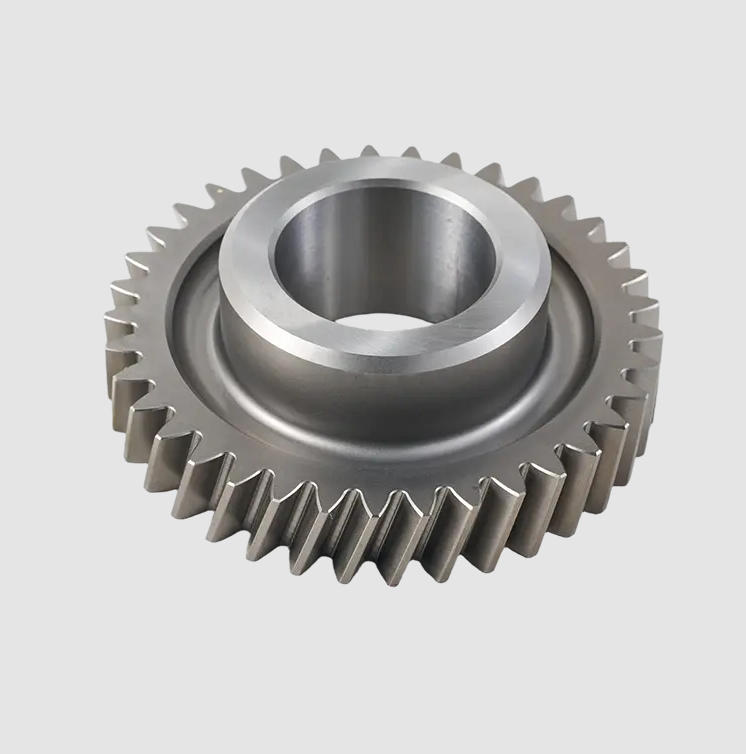
Heat Expansion Quietly Alters Alignment
Inside industrial machinery, temperatures rarely stay constant.
As a precision gear shaft operates continuously, heat gradually changes the dimensions of both the shaft and surrounding housing components. Different materials expand at different rates, which may slowly shift the original alignment condition during operation.
This becomes more noticeable in:
- high-speed reducers
- servo systems
- automotive transmission assemblies
- robotic equipment
- industrial automation systems
Actually, some transmission systems run quietly during startup but become noisier only after reaching stable operating temperature.
Bearing Condition Influences Shaft Stability
A precision gear shaft depends heavily on surrounding bearing support.
Even if the shaft itself is machined accurately, worn bearings may introduce slight radial movement during rotation. Once the shaft centerline shifts repeatedly under load, the gear contact pattern changes gradually across the tooth surface.
Technicians sometimes notice:
- uneven tooth marks
- rising vibration
- irregular rotational sound
- changing backlash behavior
- localized heat buildup
Actually, many early-stage gear noise problems originate from bearing movement rather than direct gear damage.
Surface Finish Affects Lubrication Behavior
The surface quality of a precision gear shaft influences more than visual appearance.
Microscopic roughness affects how lubricating oil spreads across rotating contact areas. If the shaft surface becomes too rough or inconsistent, oil film stability may weaken under high rotational load.
This impacts:
- friction control
- heat generation
- wear resistance
- rotational smoothness
- long-term durability
Actually, certain lubrication problems begin from surface texture variation rather than insufficient oil quantity itself.
Dynamic Load Changes During Real Operation
In laboratory testing, rotational systems often run under relatively stable conditions.
Inside real production environments, however, a precision gear shaft experiences constantly changing loads caused by acceleration, stopping cycles, vibration, and shifting torque demand. These dynamic forces gradually influence shaft stress distribution over time.
This becomes common in:
- packaging machinery
- CNC equipment
- conveyor systems
- printing machines
- automated assembly lines
Actually, shafts that perform well under static testing may behave differently once repeated load variation enters the system.
Machining Precision Alone Does Not Guarantee Stability
Many people assume a precision gear shaft only depends on tight machining tolerances.
Inside transmission manufacturing, however, stability also depends on heat treatment, material consistency, concentricity control, and assembly accuracy working together. A highly precise shaft may still develop vibration problems if surrounding components introduce uneven stress during installation.
Manufacturers therefore often evaluate:
- concentric alignment
- hardness consistency
- thermal deformation
- balance stability
- assembly interaction
Actually, long-term rotational stability usually depends on the entire transmission environment rather than one single component dimension.
Small Rotational Changes Become Larger Over Time
To outside observers, a precision gear shaft may appear to be a simple cylindrical mechanical component.
Inside real machinery systems, however, the shaft quietly controls alignment stability, load transfer, rotational balance, lubrication behavior, and vibration performance throughout continuous operation.
The difficult part is not making the shaft rotate.
It is keeping the entire transmission system stable after thousands of operating hours where heat, vibration, torque fluctuation, and mechanical stress continuously interact during real industrial use.
-
William Weber:
Phone: +86-13968651722
E-mail: sales01@hsgearworks.com -
Address:
No.9 East Section, Jianan Avenue, Taizhou Bay New District, Taizhou City, Zhejiang Province, China, 318052
Copyright @ Zhejiang Haoshun Machinery Technology Co., Ltd. All Rights Reserved.
Precision Gears Manufacturer
