

 English
 Español
 Deutsch

Why Does A Transmission Gear Shaft Wear Unevenly?
Where Engineering Excellence Meets Reliable Transmission
A transmission gear shaft rarely attracts much attention during daily operation. When a gearbox is running smoothly, technicians are usually focused on noise levels, temperature readings, lubrication schedules, or production output rather than the shaft itself.
That changes when maintenance crews open a gearbox during an overhaul and discover that wear patterns are not evenly distributed.
One side may show visible polishing.
Another section may appear almost untouched.
Sometimes the gears remain in acceptable condition while the shaft surface tells a different story.
Situations like this often guide to an interesting question: if the gearbox has been operating under the same load for years, why doesn't every part wear at the same rate?
The Load On Paper Is Not Always The Load In Reality
Engineering drawings often present a clean picture of power transmission.
In actual factories, conditions are rarely that simple.
Machines start and stop.
Operators change production speeds.
Materials vary from batch to batch.
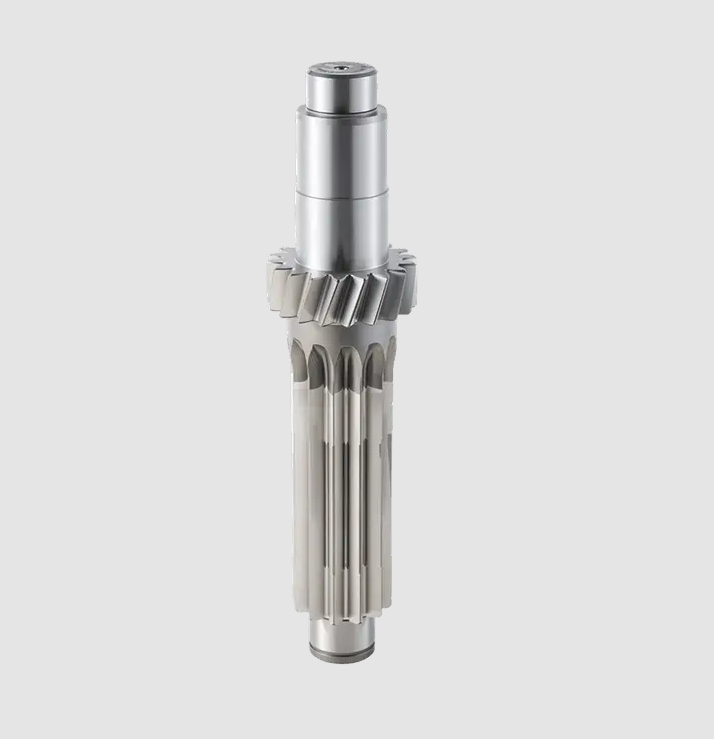
Occasional overloads occur even when nobody notices them at the time.
As a result, a transmission gear shaft may spend only a small portion of its life operating exactly as originally intended.
Maintenance records from industrial plants often show that equipment running under variable loads develops different wear characteristics compared with systems operating under stable conditions.
The shaft reflects that history.
Alignment Changes Can Develop Slowly
One gearbox technician once described a repair job where operators complained about a slight increase in vibration.
Nothing dramatic had happened.
Production continued normally.
The vibration level was simply a little higher than before.
After inspection, the issue was traced to a small alignment change that had developed gradually over several years.
No single event caused it.
The machine foundation had settled slightly.
Couplings compensated for the change.
The gearbox continued running.
Eventually, the effect became visible during inspection.
What made the case interesting was that the wear appeared in a specific area rather than across the entire shaft surface.
For experienced technicians, patterns like this often reveal more information than measurements alone.
Lubrication Reaches Some Areas More Easily Than Others
People often discuss lubrication as though every surface inside a gearbox receives the same treatment.
Reality can be more complicated.
Oil movement depends on operating speed, gearbox design, temperature, and internal geometry.
Some areas experience continuous oil exposure.
Others rely on splash patterns or circulation conditions that change during operation.
Because of this, two locations on the same transmission gear shaft may spend years working under slightly different lubrication conditions.
The difference may be small on any given day.
After thousands of operating hours, it becomes easier to see.
What Maintenance Teams Usually Notice First
Interestingly, uneven wear is not always discovered through scheduled inspections.
Many findings begin with observations that seem unrelated.
A technician hears a subtle change in sound.
A vibration reading drifts upward.
A routine oil analysis produces results that differ from previous reports.
These clues encourage a closer look.
Once the gearbox is opened, the shaft often becomes part of a larger story about how the equipment has been operating over time.
A transmission gear shaft does more than transfer torque between components. It records the effects of loading patterns, alignment conditions, lubrication behavior, and operating history. For this reason, experienced maintenance personnel often study wear marks carefully rather than viewing them simply as damage.
In many cases, the surface of the shaft reveals what the machine has been experiencing long before operators became aware that anything had changed.
-
William Weber:
Phone: +86-13968651722
E-mail: sales01@hsgearworks.com -
Address:
No.9 East Section, Jianan Avenue, Taizhou Bay New District, Taizhou City, Zhejiang Province, China, 318052
Copyright @ Zhejiang Haoshun Machinery Technology Co., Ltd. All Rights Reserved.
Precision Gears Manufacturer
