

 English
 Español
 Deutsch

Why Does A Companion Flange Get Replaced During Other Repairs?
Where Engineering Excellence Meets Reliable Transmission
A companion flange is rarely the component that brings a machine into the workshop.
Technicians are usually called because of vibration, leakage, unusual drivetrain behavior, or wear discovered elsewhere in the system. Yet during many repairs, the companion flange ends up receiving attention even though it was not part of the original complaint.
This surprises some equipment owners.
The flange looks intact.
There are no visible cracks.
The mounting holes appear normal.
From the outside, it may seem unnecessary to inspect it closely.
However, experienced maintenance personnel often take a different view. They know that some components reveal their condition only after surrounding parts have been removed.
The Inspection Often Starts By Accident
A repair technician working on a driveline assembly once described a common situation.
The original job involved replacing worn universal joints. Once the assembly was disassembled, the team decided to inspect nearby components before reassembly.
Nothing unusual was expected.
Then someone noticed a faint contact pattern around the mounting surface.
It was not severe enough to stop operation.
It was not visible before disassembly.
Yet it suggested that the mating parts had not been sharing load exactly as intended.
The universal joint was not the only part carrying the history of the drivetrain.
The companion flange had been recording it as well.
Wear Does Not Always Appear Where People Expect
Many people imagine wear as something dramatic.
Deep grooves.
Broken teeth.
Obvious damage.
In practice, maintenance inspections often focus on much smaller details.
A polished area that has gradually expanded.
A contact surface that looks slightly different from previous inspections.
A change in bolt seating marks.
None of these observations automatically indicate a problem. They simply help technicians understand how forces have been moving through the assembly over time.
In heavy equipment, commercial vehicles, and industrial machinery, these subtle clues can be more informative than obvious damage because they appear earlier.
The Component Remembers Operating History
One reason technicians pay attention to a companion flange is that it sits at an important connection point within the drivetrain.
Every acceleration, load change, shock event, and operating cycle passes through that connection.
Most of those events are forgotten by the operator almost immediately.
The machine continues working.
Production continues.
The vehicle returns to service.
The flange, however, experiences every one of those cycles.
Years later, inspection marks may reveal patterns that maintenance records never captured.
This is why two machines with similar service hours sometimes show very different component conditions.
Operating history matters as much as operating time.
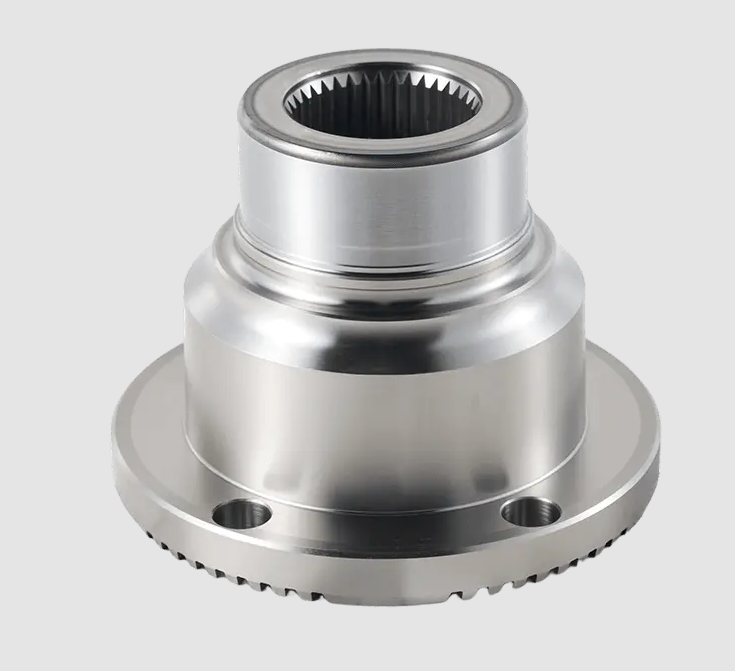
What Experienced Mechanics Usually Look For
Interestingly, experienced mechanics often spend less time searching for major defects and more time studying contact areas.
They look at how components fit together.
They compare wear patterns from one side to another.
They pay attention to surfaces that rarely attract attention during normal operation.
A companion flange may seem like a simple connecting part, but it often provides valuable information about alignment, loading conditions, and drivetrain behavior. During a repair, replacing a nearby component may solve the immediate problem. Inspecting the flange helps determine whether the underlying operating conditions have changed as well.
That is why many workshops examine these parts carefully whenever the opportunity arises. Sometimes the component that was not responsible for the repair ends up telling the useful story about the machine's past operation.
-
William Weber:
Phone: +86-13968651722
E-mail: sales01@hsgearworks.com -
Address:
No.9 East Section, Jianan Avenue, Taizhou Bay New District, Taizhou City, Zhejiang Province, China, 318052
Copyright @ Zhejiang Haoshun Machinery Technology Co., Ltd. All Rights Reserved.
Precision Gears Manufacturer
