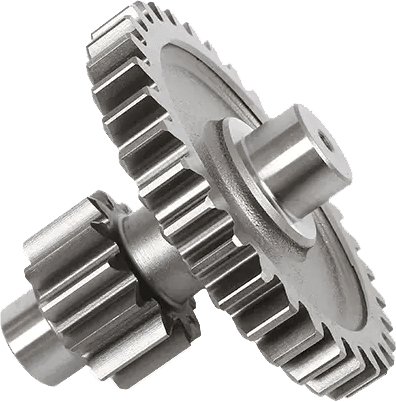
Industrial power transmission systems play a vital role in the energy conversion and transfer processes within various types of mechanical equipment. Among their core components, gears hold fundamental significance in the distribution of torque, the regulation of rotational speed, and the stable output of power. As different types of industrial equipment impose distinct requirements on transmission structures, the design and manufacturing methods for gears have evolved to exhibit considerable diversity.
Within the overall transmission chain, gears typically operate in conjunction with components such as shafts, bearings, and couplings, facilitating power transmission through the process of meshing. The operational stability of these gears not only impacts equipment efficiency but also directly influences the overall smoothness of the machine's operation.
Gear Materials and Processing Technology Characteristics
During prolonged operation, industrial gears are subjected to high contact stresses and cyclic loads; consequently, material selection typically prioritizes alloy steels, carburized steels, and certain high-strength cast steels. Through heat treatment processes—such as carburizing and quenching, or tempering—the surface hardness of the gear teeth can be enhanced while simultaneously increasing the toughness of the core material, thereby extending the gear's service life.
In the manufacturing phase, primary gear-forming methods include hobbing, shaping, and grinding. Different processing techniques are suited to meet varying requirements regarding precision grades. For instance, gear grinding is typically employed in high-precision transmission applications, whereas hobbing is better suited for the mass production of medium-precision gears.
Furthermore, manufacturing precision directly influences the levels of noise and vibration generated during gear meshing; therefore, the production process incorporates multiple inspection stages, including the verification of tooth profile errors and the analysis of tooth pitch deviations.
Common Gear Types and Structural Applications
Industrial transmission systems feature a diverse array of gear structures, with different configurations tailored to specific transmission requirements. The following outlines common gear types and their fundamental characteristics:
| Gear Type | Structural Characteristics | Primary Application Scenarios | Operational Characteristics |
| Cylindrical Gears | Tooth surfaces parallel to the axis | General mechanical equipment | High transmission efficiency |
| Bevel Gears | Axes intersect | Steering and angular transmission | Capable of changing transmission direction |
| Worm Gears | Axes are spatially non-intersecting | Speed reduction devices | High transmission ratio; compact structure |
| Planetary Gears | Multi-gear combination structure | Precision transmission systems | Balanced load-bearing capacity |
In practical applications, these structures are typically selected based on specific load conditions and spatial layout constraints to ensure that the operational requirements of various industrial equipment are fully met.
Operation, Maintenance, and Factors Influencing Wear
During long-term operation, gears inevitably experience wear; the primary factors influencing this include lubrication conditions, load fluctuations, and meshing precision. Insufficient lubrication, in particular, increases the coefficient of friction between gear teeth surfaces, thereby accelerating surface fatigue.
During maintenance, common inspection procedures include assessing the extent of tooth surface pitting, checking for cracks at the tooth roots, and monitoring changes in meshing clearance. Regular inspections allow for the timely detection of potential issues, thereby preventing equipment failure during high-load operations.
Furthermore, environmental factors—such as dust and temperature fluctuations—can also impact gear lifespan. Consequently, in certain industrial settings, sealing structures or circulating lubrication systems are implemented to optimize operating conditions.
Manufacturing Precision and Assembly Consistency Requirements
The overall performance of a gear system depends not only on the quality of individual gears but is also closely tied to assembly precision. During the actual assembly process, strict control over center distance errors and shaft axis parallelism is essential to ensure smooth gear meshing.
Manufacturing precision is typically categorized into various grades, with each grade corresponding to specific application scenarios. For instance, high-speed machinery demands a high degree of dynamic balance in its gears, whereas low-speed, high-torque equipment places greater emphasis on structural strength and load-bearing capacity.
Upon completion of assembly, both no-load and load-bearing test runs are required to validate the stability of the transmission system and the integrity of the gear meshing.
As fundamental mechanical components, industrial transmission gears are supported by a comprehensive technical framework encompassing structural design, material selection, and manufacturing processes. Through judicious selection and diligent maintenance, these gears can deliver stable and reliable power transmission across a wide range of industrial environments.