

 English
 Español
 Deutsch

E-Drive Gear Manufacturing Faces New Noise Control Demands
Where Engineering Excellence Meets Reliable Transmission
An internal combustion engine masks gear whine that would be immediately obvious in an electric vehicle, since there is no engine noise left to cover it once the motor becomes the loudest thing under the hood. E-drive gear manufacturing has had to adapt to this reality quickly, because the same tooth mesh pattern that produced acceptable NVH performance in a traditional transmission can sound noticeably worse once it sits inside a cabin with no combustion noise to blend into. Suppliers new to e-drive gear manufacturing often discover this the hard way, when a gear that passed every dimensional check on a conventional program generates customer complaints once it reaches an EV production line.
Why Motor Speed Changes the Engineering Problem
E-drive gear manufacturing now routinely deals with input speeds several times higher than a conventional internal combustion transmission ever handled, since electric motors commonly operate at speeds where a traditional gearbox would already be well past its designed range. This higher speed changes how tooth contact behaves under load, how quickly heat builds in the mesh, and how sensitive the entire gear train becomes to even minor profile errors that would have gone unnoticed at lower rotational speeds. Buyers sourcing reduction gears for an EV drivetrain should confirm a supplier has specific experience at these elevated speed ranges, since general automotive gear experience does not automatically transfer to this operating regime.
High Speed Gear Noise Control Techniques
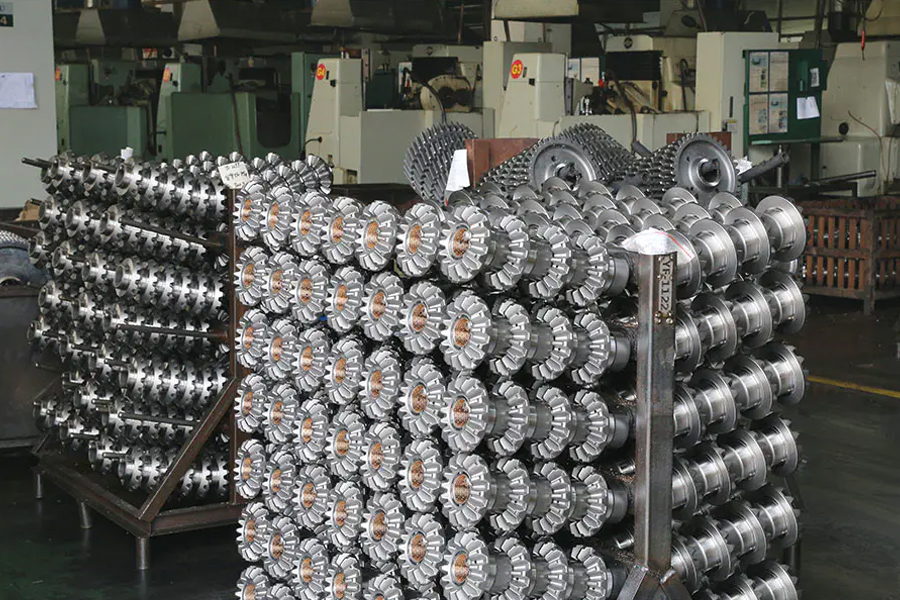
High speed gear noise control relies heavily on tooth profile modification, including crowning and tip relief, applied with tighter tolerances than a standard automotive gear typically requires, since even a small deviation in tooth geometry produces an audible whine at the elevated mesh frequencies common in EV reduction gears. E-drive gear manufacturing facilities equipped to grind rather than only hob or shave gear teeth can generally hold the tighter profile tolerances this application demands, since grinding removes material more precisely after heat treatment distortion has already occurred. Buyers should ask a supplier directly which finishing process is used on reduction gear teeth, since this detail affects the finished product's noise performance more than almost any other single manufacturing variable.
EV Reducer Gear Lubrication Requirements
EV reducer gear lubrication differs meaningfully from a traditional transmission fluid system, since electric drive units often run with less oil volume and rely more heavily on splash or targeted lubrication to reach every mesh point at the higher operating speeds involved. A gear design and housing layout not engineered together for this specific lubrication approach can develop localized dry-running conditions that accelerate wear even when the overall oil level appears adequate. Buyers should confirm that a supplier's e-drive gear manufacturing process accounts for the actual lubrication system of the target application rather than assuming a gear designed for traditional splash lubrication will perform identically in a lower-volume EV housing.
Material and Heat Treatment Adjustments for Higher Loads
E-drive gear manufacturing for high-torque electric motor applications often requires heat treatment adjustments beyond what a comparable internal combustion gear would need, since instant torque delivery from an electric motor creates loading conditions during acceleration that differ from the more gradual torque buildup of a combustion engine. Buyers should ask whether a supplier has adjusted its carburizing or induction hardening parameters specifically for this loading profile, rather than applying the same heat treatment recipe used on a conventional transmission gear of similar size. A supplier that treats this as a copy-paste exercise from an existing internal combustion part number is more likely to under-engineer the case depth or core hardness needed for the actual duty cycle an EV reduction gear experiences.
Quality Control and Bulk Supply for EV Programs
Buyers scaling an EV program should confirm that e-drive gear manufacturing quality control includes noise testing on a representative sample from each production batch, not only dimensional inspection, since a gear can pass every dimensional check and still produce unacceptable NVH performance once installed in a quiet electric drivetrain. Certification covering the supplier's quality management system, along with documented process capability for the tighter tolerances e-drive gear manufacturing demands, should be confirmed before committing to a bulk order, since a supplier without demonstrated experience at EV-specific speed and load conditions carries meaningfully more risk than one with an established track record in this exact application.
-
William Weber:
Phone: +86-13968651722
E-mail: sales01@hsgearworks.com -
Address:
No.9 East Section, Jianan Avenue, Taizhou Bay New District, Taizhou City, Zhejiang Province, China, 318052
Copyright @ Zhejiang Haoshun Machinery Technology Co., Ltd. All Rights Reserved.
Precision Gears Manufacturer
