

 English
 Español
 Deutsch


Marine Gear Manufacturing Balances Axial Thrust Through Herringbone Teeth
Where Engineering Excellence Meets Reliable Transmission
Marine Gear Manufacturing has to settle the axial load created by helical teeth before it settles anything else, and herringbone gears are one of the established answers. A propeller shaft turns far slower than the engine that drives it, so a reduction gearbox sits between the two, and the gears inside run for long hours at steady load. Smooth meshing suits that duty, and smooth meshing comes from helical teeth, which carry a side effect that shapes how the gears are made.
Helical Teeth Smooth The Mesh And Push Sideways
Spur gears mesh along a line parallel to the shaft and suit low-speed work. Helical teeth are cut at an angle, so contact begins gradually and spreads across the tooth, which gives quieter meshing and suits continuous operation. The angle also splits the tooth force into a part that turns the gear and a part that pushes along the shaft. At a 20-degree helix angle, the sideways part is about 36 percent of the turning force.
In a Marine Gearbox carrying high torque, that axial force is large enough to dictate bearing size and housing stiffness. Marine Gear Manufacturing therefore starts from the tooth form, because the tooth form decides how much sideways load the rest of the gearbox has to absorb.
Herringbone Teeth Cancel The Thrust Inside The Gear
A Herringbone Gear places two helical halves side by side with opposite hands. Each half pushes sideways against the other, so the axial forces balance within the gear itself. The shaft bearings are relieved of that load, and the gear runs with more stability, which is why herringbone sets appear in propulsion reducers and other continuous-duty drives.
The benefit comes with a manufacturing condition: the two halves have to behave as one tooth form. A herringbone pair is not two helical gears sharing a hub, and Marine Gear Manufacturing treats it that way from blank to final inspection.
Production Has To Match Two Halves
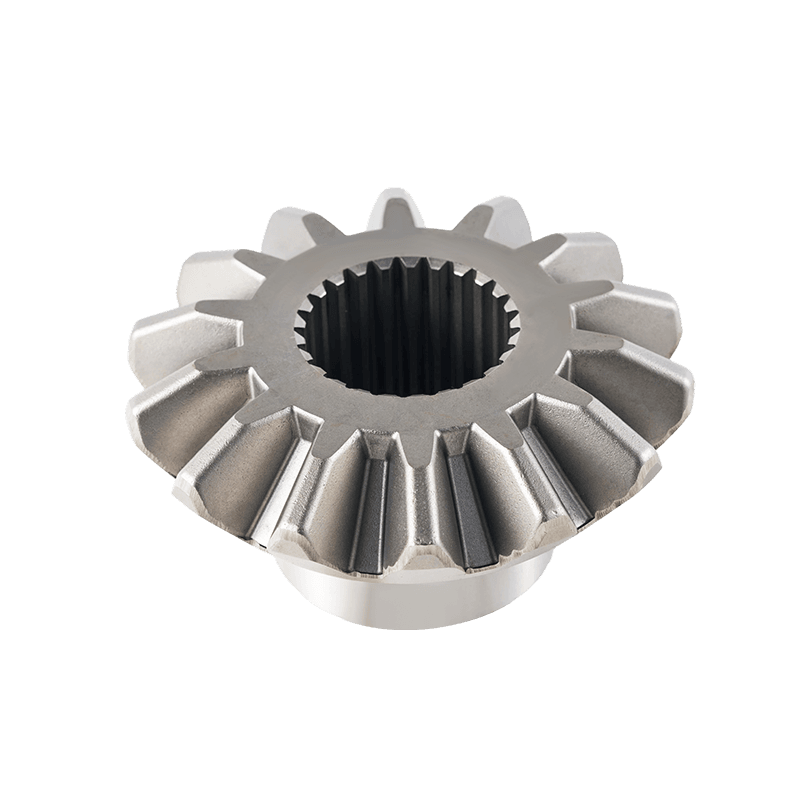
In Marine Gear Manufacturing, the balance only holds when both halves carry equal load. Lead and profile errors that a single helical gear can tolerate may leave one half carrying more than the other, which brings back the sideways force the herringbone form was chosen to remove. Many gears of this form carry a relief groove between the halves so cutting and grinding tools can run out, and gears without a groove call for specialized machines. In many double helical reducers, one member is left free to float axially, so the halves share load on their own, and that arrangement works only when the two halves are accurate and matched in phase.
Haoshun Gearworks lists herringbone models Z22 and Z27 under its marine propulsion gears, and supports marine programs with practical design-for-manufacturing feedback on blanks, heat treatment, and interfaces. Precision in the gear profile reduces meshing error, which lowers vibration and noise, so Marine Gear Manufacturing puts its tightest tolerances on the tooth form.
Heat Treatment Has To Treat Both Halves Alike
Internal gears in a marine gearbox are typically made from high-strength alloy steel, carburized for surface hardness, quenched for overall strength, and tempered for toughness. Distortion during that cycle is the main risk to matched halves, because a gear that twists slightly loses the match that the earlier machining set up. Controlled blanks and a heat treatment cycle tuned for distortion control keep both halves moving together, and grinding after hardening restores profile and lead.
Inspection points then verify what matters on the drawing: key dimensions, functional interfaces, and the two halves against each other. A Herringbone Gear that passes those points leaves the furnace in the same condition on every unit of a series, and Marine Gear Manufacturing depends on that repeatability, since a propulsion gearbox is built from a small number of large parts that have to mesh as designed.
Shipping Closes The Process
In Marine Gear Manufacturing, humidity and salinity matter, and corrosion-sensitive logistics begin before the gearbox is assembled, when parts travel between factories. Finished gears leave with stable part marking and packaging tailored for overseas transport, so warehouse and assembly teams can identify and handle them quickly. EN 10204 3.1 material certificates and inspection reports travel with the shipment, and traceability is kept for export programs.
For repeat orders, process parameters stay fixed to limit variation and shorten re-approval cycles, which matters for a Marine Gearbox program that places the same parts again each year. Gears supplied this way arrive with the same documentation, marking, and packing as the previous lot, and Marine Gear Manufacturing closes with the paperwork matching the parts.
-
William Weber:
Phone: +86-13968651722
E-mail: sales01@hsgearworks.com -
Address:
No.9 East Section, Jianan Avenue, Taizhou Bay New District, Taizhou City, Zhejiang Province, China, 318052
Copyright @ Zhejiang Haoshun Machinery Technology Co., Ltd. All Rights Reserved.
Precision Gears Manufacturer
