

 English
 Español
 Deutsch


High-End Equipment Gear Manufacturing Starts With Tooth Contact
Where Engineering Excellence Meets Reliable Transmission
High-End Equipment Gear Manufacturing is judged less by how a gear looks on a drawing than by where its teeth touch once it is carrying torque. Two gears can pass the same dimensional report and still run differently in a gearbox, because the contact between mating teeth changes as load rises, shafts bend and housings flex. Robotic joints, machine-tool drives and marine or wind gearboxes ask for that contact to stay centred, and that is where the manufacturing work concentrates.
What a Contact Pattern Shows
A simple shop test reveals a lot. One gear is coated with marking compound, the pair is rolled together under light load, and the compound transfers a patch onto the mating flank. A patch that sits in the middle of the tooth, well clear of both ends and the tip, shows a healthy fit. A patch pushed to one end shows that the shafts are not parallel to the tolerance the design needs, or that the teeth have been cut with an error.
The light-load result is a starting point. Under full torque, the patch moves, because everything holding the gears deflects a little. That movement decides whether the load is shared across the tooth width or crowds into one edge, and controlling it is a large part of High-End Equipment Gear Manufacturing.
Why Loaded Teeth Move
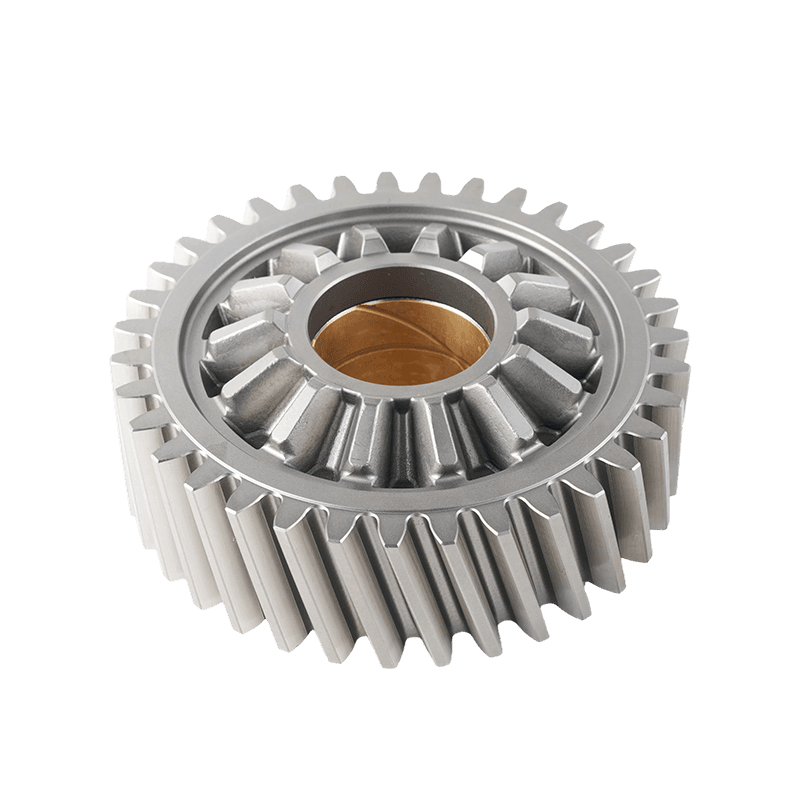
Take a helical gear with a face width of 40 mm. Under load, bending of the shaft and clearance in the bearings can tilt one gear against the other by 20 micrometres across that width. That is a slope of 0.5 micrometres per millimetre, about 0.03 degrees, and it sounds negligible. Yet on a hardened tooth flank it shifts the contact toward one end, so the same torque now acts on a smaller area and local stress climbs.
Designers answer with intentional modifications. A crowning of roughly 10 micrometres makes the tooth very slightly barrel-shaped along its width, so a tilt of the size above still leaves the contact inside the tooth rather than on its edge. Tip relief takes a few micrometres off the tooth tip so that teeth coming into mesh do not strike each other under deflection. Both changes are small, and cutting and checking them at that scale is routine in High-End Equipment Gear Manufacturing.
How Grinding and Measurement Fit In
Carburizing and quenching harden the teeth but also move them slightly, so precision gears are usually ground after heat treatment to bring the flank back to the required form. Grinding is also where the crowning and the tip relief are produced, since a micrometre-scale shape cannot be left to chance at the hobbing stage. That is why grinding sits late in High-End Equipment Gear Manufacturing routes.
Measurement then confirms the result. A gear measuring machine traces the profile of selected teeth and prints the curves. The profile trace shows tip relief as a gentle drop at the tip of the flank, and the trace shows crowning as a shallow arc along the width. Pitch and runout checks complete the set. For a High-End Equipment Gear order, these traces are evidence that the modification on the drawing was actually cut.
How Haoshun Runs the Chain
Zhejiang Haoshun Machinery Technology Co., Ltd. is based in Taizhou Bay Industrial Park, Jiaojiang District, and covers blank forging, rough machining, precision machining, and heat treatment in-house for High-End Equipment Gear Manufacturing projects. A team of 360 includes 25 people dedicated to quality management and inspection. Keeping these stages under one roof means a change to the heat treatment recipe or the grinding allowance can be discussed with the people who run each step.
The factory's catalogue spans vehicle gears, off-highway and agricultural gears, and industrial machinery gears, with robotics and automation drives, wind turbine gearbox gears, marine propulsion gears, and oil and gas equipment gears among the categories. A High-End Equipment Gear Manufacturer in that position can pair Precision Gears with matching Gear Shafts from the same line, so the contact between them is set at one site. A pattern that sits in the middle of the tooth on a light-load roll is where each of those parts starts, and it is where High-End Equipment Gear Manufacturing at Haoshun begins.
-
William Weber:
Phone: +86-13968651722
E-mail: sales01@hsgearworks.com -
Address:
No.9 East Section, Jianan Avenue, Taizhou Bay New District, Taizhou City, Zhejiang Province, China, 318052
Copyright @ Zhejiang Haoshun Machinery Technology Co., Ltd. All Rights Reserved.
Precision Gears Manufacturer
