

 English
 Español
 Deutsch

Automobile Gear Precision Sits Above General Industrial Grades
Where Engineering Excellence Meets Reliable Transmission
A gear cut for a factory conveyor and a gear cut for a passenger car transmission can start from the same basic tooth profile, yet the two rarely share a precision grade once the drawing gets specific. An automobile gear is held to a tighter tolerance than typical industrial gearing, and that gap in precision traces back to three things a car asks of its drivetrain that a stationary machine rarely does: less weight, longer life, and less noise reaching the cabin.
Reading the precision grade correctly
Gear precision grade is expressed on an ISO grading scale, and lower numbers mean tighter tolerances on tooth profile, spacing and runout. General industrial gearing commonly sits in the ISO 6 to 8 range, a level that suits equipment where a small amount of backlash or profile error goes unnoticed under normal operation. An automobile gear in a passenger vehicle transmission typically falls in the ISO 4 to 7 range instead, and some passenger car transmission gears are held to Grade 4, among the tightest tolerances gear manufacturing commonly produces.
This tighter gear precision grade is not a marketing figure; it changes how the tooth flank gets finished after the basic cutting operation. Profile crowning and flank modification, small deliberate deviations from an otherwise straight tooth profile, reduce the impact that occurs as two teeth come into and out of mesh at speed. Skipping these finishing steps on an automobile gear would leave the tooth profile technically within a looser tolerance band, but the meshing impact at highway speed would translate directly into cabin noise the driver notices immediately, which is a failure mode a factory gearbox rarely has to answer for.
Why weight enters the tolerance conversation
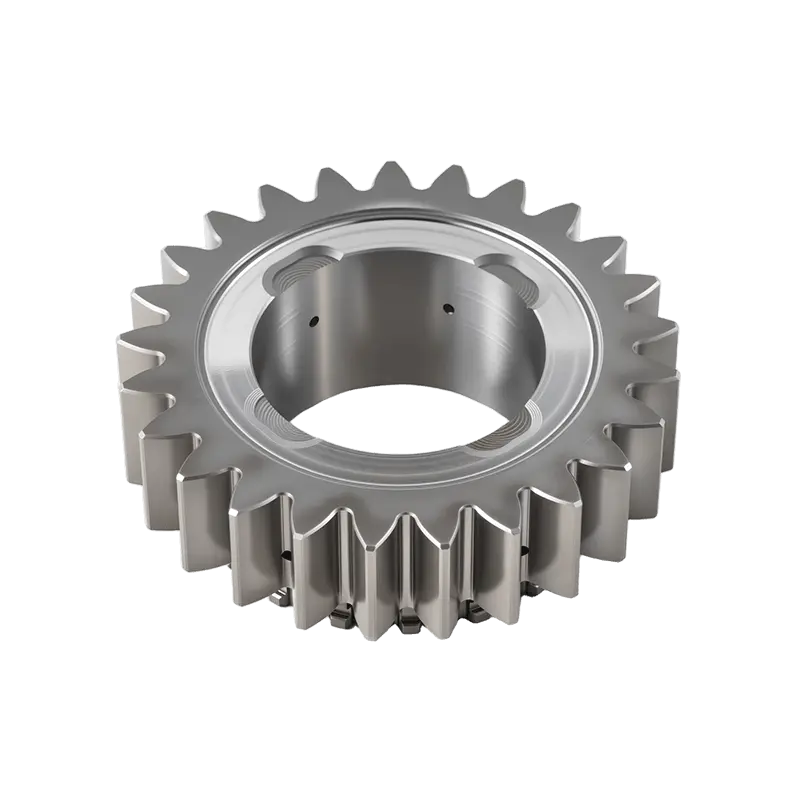
Passenger vehicles carry a direct incentive to shed unsprung and rotating mass that a stationary industrial gearbox does not share. An automobile gear is frequently designed with a thin-walled web or a reduced tooth width relative to the load it carries, using high-strength alloy steel to hold structural capacity despite the reduced material. Cutting material this closely to the strength limit leaves far less margin for a tooth to drift out of profile before it starts affecting how smoothly the gear meshes with its pair, which is one reason the tighter tolerance band exists alongside the lightweight design rather than in spite of it.
A general industrial gear built with generous wall thickness carries enough structural reserve that a modest profile deviation rarely shows up as a functional problem. An automobile gear built lighter has less of that reserve, so the precision grade and the lightweight design work together rather than as two separate specifications a buyer happens to request at the same time.
Fatigue life measured in vehicle years, not maintenance intervals
A stationary industrial gear typically runs on a maintenance schedule, with wear tracked and parts replaced at planned intervals over the equipment's service life. An automobile gear in a mainstream passenger transmission is designed to run for the vehicle's entire service life without replacement under normal conditions, accumulating hundreds of millions of meshing cycles along the way with no scheduled midlife swap built into the design.
That difference in expected lifespan shapes both the material choice and the heat treatment applied to an automobile gear. Carburizing and quenching bring surface hardness into the 58 to 63 HRC range on many automotive gear grades, while the core retains enough toughness to absorb shock loading from sudden acceleration or a rough gear change, a combination tuned specifically for the repeated, high-cycle loading a vehicle transmission sees over years of ordinary driving rather than the more predictable load pattern of a fixed industrial application.
Specifying the right grade for the application
Buyers sourcing gearing across both automotive and general industrial lines benefit from treating precision grade as a functional requirement tied to the application, not a single number applied uniformly across every part on an order. An automobile gear destined for a passenger car transmission genuinely needs the tighter ISO 4 to 7 range and the associated tooth finishing, while a support gear inside a less noise-sensitive commercial vehicle assembly may perform adequately at a somewhat looser grade within that same broad range.
Matching the gear precision grade to where a part actually sits in the drivetrain, rather than specifying the tightest available tolerance across an entire bill of materials, keeps manufacturing cost aligned with what the application genuinely requires. An automobile gear correctly graded for its position in the transmission delivers the fatigue life, weight and noise performance the vehicle needs without paying for precision the part was not going to use.
-
William Weber:
Phone: +86-13968651722
E-mail: sales01@hsgearworks.com -
Address:
No.9 East Section, Jianan Avenue, Taizhou Bay New District, Taizhou City, Zhejiang Province, China, 318052
Copyright @ Zhejiang Haoshun Machinery Technology Co., Ltd. All Rights Reserved.
Precision Gears Manufacturer
