

 English
 Español
 Deutsch

Where Do Trucks Use A Crawler Gear System?
Where Engineering Excellence Meets Reliable Transmission
Heavy vehicle engineers rarely talk about top speed when they discuss a crawler gear in truck applications, because the entire point of this gear range is the opposite: moving forward at walking pace while delivering torque that a standard transmission range simply cannot produce. That trade-off is why this gearing shows up in specific truck categories rather than across the entire commercial fleet.
Construction And Earthmoving Support Vehicles
Concrete mixer trucks and material haulers working on active job sites depend on a crawler gear in truck drivetrains to maintain precise, controlled movement across uneven ground, mud, or loose fill material. Which conditions make this gear range necessary rather than optional? Sites without paved access roads, since a standard low gear still moves the vehicle faster than a spotter can safely guide it through tight clearances between excavators, scaffolding, and stockpiled material. The crawler range lets a driver creep forward in small increments while a ground guide directs positioning, something a conventional gear cannot replicate without excessive clutch slipping or brake modulation.
Are dump trucks and haul trucks equipped the same way as mixers? Off-highway haul trucks operating in quarries and mining sites often integrate a similar low-range gear set, though the surrounding drivetrain components differ considerably given the scale of the vehicles involved. A heavy-duty gear system built for a mining haul truck handles substantially higher torque loads than the equivalent system in a highway-legal concrete mixer, even though both rely on the same underlying principle of trading speed for control.
Fire And Rescue Apparatus
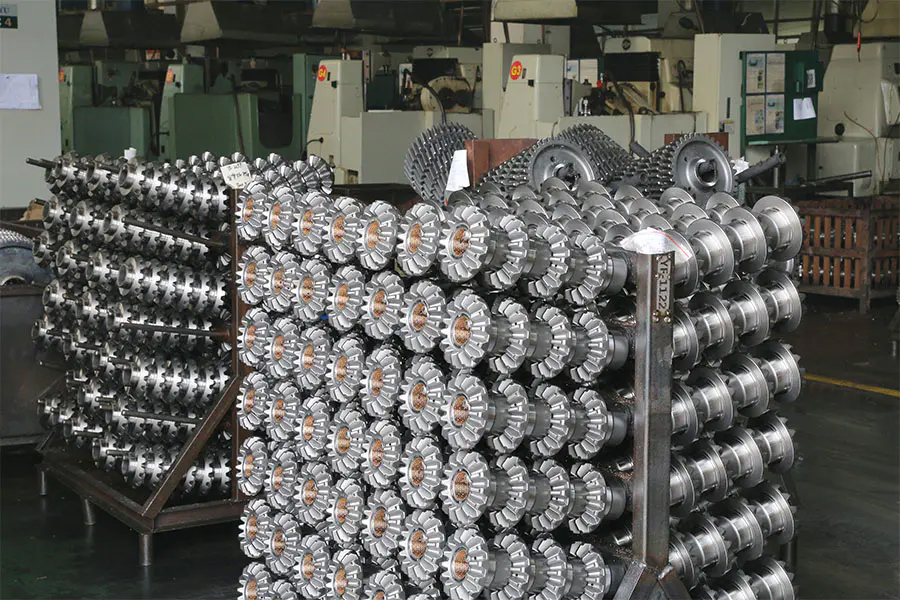
Fire trucks equipped with aerial ladders or elevated platforms use a crawler gear in truck configuration for a different reason: positioning the vehicle with enough precision to place an aerial device against a building without repeated forward-and-reverse adjustments. Where does this precision matter during an active response? Narrow urban streets and alleyways, where a driver needs to inch the truck into position while a crew member spots clearance around parked vehicles, utility poles, and overhead wires. The auxiliary gearbox controlling this low-range function typically engages independently from the main transmission, allowing the operator to shift into crawler range only when positioning maneuvers require it.
Military And Off-Road Transport
Military transport vehicles operating across unimproved terrain rely on a crawler gear in the truck drivetrain to maintain traction and control across sand, mud, and rocky surfaces where wheel slip becomes a constant risk at normal driving speeds. Do these vehicles use the crawler range differently than civilian trucks? Sustained low-speed operation across long distances is more common in military applications, since convoy movement across unprepared terrain sometimes requires extended periods in the lower available gear rather than brief positioning maneuvers, placing different durability demands on the off-road transmission components involved.
Utility And Line Service Trucks
Bucket trucks and utility line vehicles use a similar low-range gear system when positioning near overhead power lines or during pole-setting operations. Who typically requests this feature when specifying a utility vehicle? Fleet managers oversee crews that work in residential areas with limited setback from structures, since precise positioning reduces the risk of contact with fences, mailboxes, or landscaping during setup at a job location. A crawler gear in a truck system gives these crews the same fine control that construction and fire service vehicles rely on, adapted to the lighter chassis typical of utility fleets.
Agricultural And Specialty Applications
Grain trucks and agricultural transport vehicles operating across field access roads occasionally specify a crawler gear in the truck option as well, particularly for vehicles that need to navigate soft or uneven ground between a field and a paved loading area. Which component typically limits how low the gear ratio can go in these applications? Axle and differential capacity, since an extremely low gear ratio places additional torque load on downstream drivetrain components, requiring the rest of the vehicle's drivetrain to be rated accordingly rather than treating the crawler gear as an isolated add-on.
Across every one of these categories, the underlying requirement stays the same even as the vehicle type changes considerably: whenever a truck needs sustained, controlled movement at speeds far below normal driving range, a crawler gear in truck configuration provides the torque and precision that a standard transmission range was never designed to deliver in the place.
-
William Weber:
Phone: +86-13968651722
E-mail: sales01@hsgearworks.com -
Address:
No.9 East Section, Jianan Avenue, Taizhou Bay New District, Taizhou City, Zhejiang Province, China, 318052
Copyright @ Zhejiang Haoshun Machinery Technology Co., Ltd. All Rights Reserved.
Precision Gears Manufacturer
