

 English
 Español
 Deutsch

Commercial Vehicle Gear Manufacturing Treats Each Gear Position Differently
Where Engineering Excellence Meets Reliable Transmission
Commercial Vehicle Gear Manufacturing covers a family of parts that look similar on a drawing and work very differently inside a gearbox. A truck transmission holds low gears that haul a loaded vehicle away from a stop, upper gears that run for hours at cruise, and reverse and auxiliary gears that engage only briefly. Zhejiang Haoshun Machinery Technology Co., Ltd. in Taizhou, Zhejiang, makes countershaft gears, speed gears, reverse gears, idler gears, and PTO gears, and each position has its own duty.
Low Gear Carries the Highest Torque
Low gear multiplies engine torque by the largest factor, because it has to move a heavy vehicle from rest. The teeth of a 1st-gear pair are loaded hard at low speed, so the risk is tooth root bending, a crack that starts at the base of a tooth under a repeated heavy push. Wide tooth faces, strong root fillets, and a tough core help a low gear survive a loaded start on a grade. Commercial Vehicle Gear Manufacturing for this position puts bending strength at the top of the list.
Upper Gears Collect the Mileage
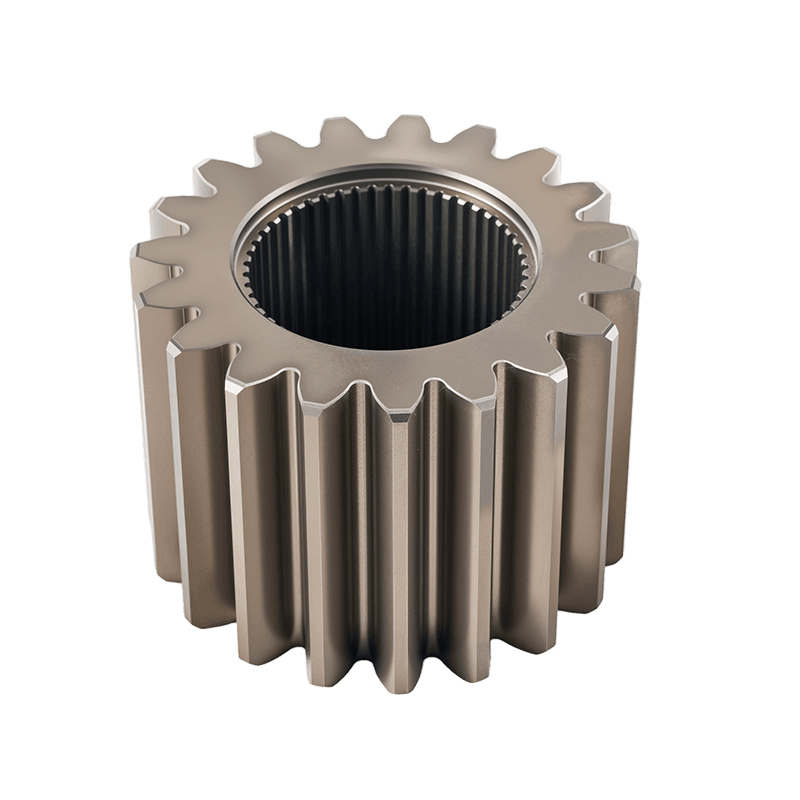
A truck covers much of its distance in the upper gears, where torque is lower and speed is higher, and Commercial Vehicle Gear Manufacturing for these gears is judged by durability over mileage. The wear that matters there is surface fatigue, the slow pitting of tooth flanks after millions of contacts. The 3rd speed gear and the 1st and 3rd speed drive gears made by Zhejiang Haoshun Machinery Technology Co., Ltd. sit in this world of long running time, where speed gears earn their keep through mileage. Surface hardness and a smooth flank finish decide how long the pitting takes to start, and a quiet mesh makes the cab calmer on long hauls.
Reverse Gears Run Briefly but Meet Shock
Reverse is used for seconds at a time, so the total mileage of reverse gears is small. The risk comes from the manner of engagement, and Commercial Vehicle Gear Manufacturing for reverse parts looks at shock more than mileage. A reverse idler gear or a reverse-to-1st gear meshes while the vehicle is moving slowly or just stopped, and an abrupt shift sends a shock through the teeth. The Reverse Idler Gear and the Reverse to 1st Speed Gear in the range at this factory are examples of parts built for such short, sharp loads. Tooth profile and chamfers on the engaging end affect how smoothly they mesh, and the specific design for each part can be confirmed with the factory before ordering.
The Countershaft Works Whenever the Engine Does
In a manual gearbox, the countershaft carries a cluster of gears that stays in mesh with the input as long as the clutch is engaged. Its gears therefore turn for a large share of the vehicle's operating hours, whichever gear the driver has selected, and the speed gears on it share that duty. A countershaft 3rd speed gear shares that constant work. Bearing seats, shaft stiffness, and tooth accuracy all shape how long such a gear holds its alignment. In Commercial Vehicle Gear Manufacturing, gear geometry and shaft runout both matter for countershaft parts.
Transfer Case and PTO Gears Face Variable Duty
Rear transfer case idler gears, available in Type A and Type B, carry power to driven axles, and Commercial Vehicle Gear Manufacturing for them has to allow for uneven loads. PTO gears feed power to pumps, mixers, and other equipment, and a PTO can sit at a standstill under heavy load while the truck is parked. That mix of stop-start torque and long idle running differs from a road gear. A Commercial Vehicle Gear Manufacturing program that includes PTO gears, gear sleeves, gear rings, and companion flanges has to account for steady, shock, and standstill loads in the same product family.
Matching Process to Position
Zhejiang Haoshun Machinery Technology Co., Ltd. forges blanks, rough machines, precision machines, and heat treats in-house, so one process chain serves every gear position. Each position can then be given its own balance of hardness, core strength, and finish in Commercial Vehicle Gear Manufacturing. A low gear needs core toughness, an upper gear needs a durable flank, and a reverse idler needs shock tolerance. Module, tooth count, accuracy grade, hardness values, and material grade for each part are not stated here and can be confirmed with the factory before ordering. Commercial Vehicle Gear Manufacturing depends on defining each position's duty before the process is chosen.
-
William Weber:
Phone: +86-13968651722
E-mail: sales01@hsgearworks.com -
Address:
No.9 East Section, Jianan Avenue, Taizhou Bay New District, Taizhou City, Zhejiang Province, China, 318052
Copyright @ Zhejiang Haoshun Machinery Technology Co., Ltd. All Rights Reserved.
Precision Gears Manufacturer
